
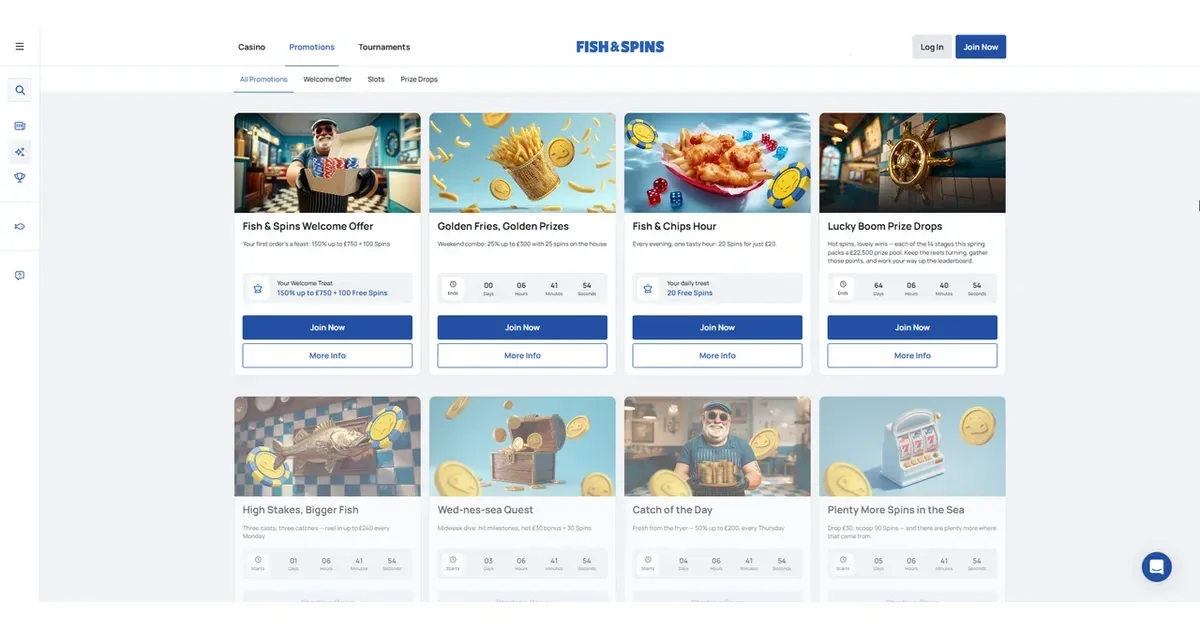
A search for the FishSpins official site turns up a column of addresses that differ from one another by a character or two, and the first useful thing to know is that a copied page can carry the brand name in its title bar as easily as the real one can. This page is an independent guide to FishSpins: it is not the operator's site, and nothing on it asks you to register, sign in or send money. What follows covers how to confirm an address yourself, how the name is spelt, and what a copied page gives away before you have typed a single character.
Which address is the real FishSpins official site?
The address that belongs to FishSpins is the one the brand publishes through its own pages and its own support channels. Type it into the address bar, or open a bookmark you saved yourself on an earlier visit, and you land where the operator's registration, cashier and terms genuinely sit.
Any list of addresses, including one printed on a guide, is worth less than the characters in front of you. A copied page is built to be found, so the address it uses will look close to the real thing: an extra letter, a hyphen where a word break belongs, a different ending after the dot.
What genuine pages show is a set of things that fit together.
- Registration is one short form, after which the site sends you to the deposit page and a confirmation email follows.
- Support runs on Live Chat at any hour, seven days a week, and by email from an address shown on the page itself.
- The welcome offer is 150% on a first deposit up to £750 with 100 free spins, and the wagering, stake cap and cashout ceiling sit in the same document as the headline.
- The cashier takes Visa and Mastercard, pays out by bank transfer, and accepts cryptocurrency for players who use it.
- One account per person is stated plainly in the terms, along with what happens to anyone who opens a second.
Pages that jump from a headline offer straight to a card form, with no terms behind the link and no support beyond a chat bubble, are working from a different script.
What is the safest way to reach FishSpins?
Type the address, or use a bookmark you created yourself. That one habit closes almost every route by which a copied page can reach you.
Links arrive from places that cannot vouch for where they lead: a text message, a direct message on social media, an advert bought by somebody else, a comment under a video. The page behind such a link can reproduce a logo, a colour scheme and an offer down to the last detail, and it costs the people running it nothing to do so.
Type it or bookmark it. Never arrive at a sign-in page or a cashier through a link you did not ask for.
A bookmark is stored in your own browser rather than on the page you are visiting, which is why it survives the sort of substitution a search result cannot. Make one on a visit you are confident about, then use it every time after that.
How do people spell FishSpins, and which spelling is right?
FishSpins is written as one word, capital F, capital S, no space and no punctuation between them. Everything else in the table below is a version that turns up when the name is typed from memory or heard rather than read.
| Spelling | What it is |
|---|---|
| FishSpins | The name as the brand writes it: one word, two capitals |
| Fishspins | The same word with the second capital dropped |
| Fish Spins | The name split in two at the join |
| Fishandspins | The full name run together as a single word |
| Fish and Spins | The full name with the conjunction written out |
| Fishspin | The final s dropped |
| Fishspinz | A z in place of the last s |
| Fishspinns | A doubled n in the second half |
None of these variants is an address in its own right, and none is claimed here to belong to anyone. They are the shapes a name takes when it is reconstructed from memory, and the reason a copied address can hide among them is simple enough: one character is all it takes to sit beside the correct spelling without matching it.
The same discipline applies in running text. The brand is FishSpins in a sentence, not Fish Spins and not Fishandspins, and a page that spells it differently in its own footer is telling you something about how carefully it was put together.
What gives a copied page away before you sign in?
Small mismatches, mostly, and they cluster in the same handful of places.
- An address differing from the real one by a letter, a hyphen, an extra word or a number.
- A welcome offer larger than the operator's own, or shaped differently: above 150%, a ceiling higher than £750, free spins counted in the hundreds.
- Terms that do not match the headline, or a footer whose legal links lead nowhere.
- Support available only inside a messaging app, with no Live Chat on the site itself.
- A request for card digits, a wallet recovery phrase or a one-time code typed into a chat window rather than the cashier.
- An app offered as a file to download rather than through a store listing you found yourself.
- Pressure to deposit quickly, or a countdown that restarts once it runs out.
- A password field somewhere it has no business being: a bonus page, a verification pop-up, an email link.
One of these on its own settles nothing. Three or four together describe a page assembled to collect details rather than to run a cashier.
Why the welcome offer is the quickest test of a page
The offer is the one claim a copied page has to get right to be convincing, and the one claim you can check against published terms in under a minute.
| Term | What it is at FishSpins |
|---|---|
| First deposit match | 150% |
| Maximum bonus | £750 |
| Free spins | 100 |
| Wagering | 40× the bonus and any free-spin winnings |
| Maximum stake while wagering | £5, bonus rounds and doubled bets included |
| Maximum cashout | £5,000; twice the deposit for players claiming in cryptocurrency |
| Top win from the free spins | £300 |
| Free spins valid for | 3 days, with the winnings held for 7 |
| Cash bonus valid for | 10 days |
| Game weighting | Slots 100%, roulette 25%, card games 10%, other games 0% |
| Minimum deposit | £20 |
A page advertising a bigger percentage, a higher ceiling, or free spins with no wagering figure attached is not describing this offer. The terms are the part a copy leaves out, because a page built to take a deposit has no reason to explain what clearing the bonus actually costs: 40 times the bonus, at no more than £5 a stake, on games that contribute in full.
The same terms carry restrictions worth reading before you deposit. Free spins expire in three days and their winnings in seven; a cash bonus lasts ten. Bonuses are not available to residents of eight countries, among them Bulgaria, Moldova and the Philippines. Only one bonus can be active at a time, and real funds are always spent before bonus funds.
What should you check in the minute before you type anything?
Eight checks, all of them possible without entering a detail.
- Read the address bar slowly, character by character, against the spelling you know.
- Confirm the padlock and an address beginning with https before the page finishes loading.
- Open the bonus rules. No wagering figure, no stake cap and no cashout ceiling behind a headline offer means you stop there.
- Compare the support options with Live Chat around the clock and an email address visible on the site.
- Look at the cashier's methods: Visa and Mastercard, bank transfer for payouts, cryptocurrency where you use it.
- Check that registration is a single short form and that the one-account-per-person rule is stated.
- Ask whether anything on the page wants your password or a code by message. Nothing legitimate does.
- Save a bookmark once you are satisfied, so the next visit needs no search at all.
What can you do if you have already entered details on a copy?
Work in order: the payment side first, then the account side, then the record.
- Change the password on every account that shared it, email first.
- Call the number on the back of your card, say what was entered and when, and ask for the card to be stopped if the details went through.
- Contact the operator's support from the real site. Live Chat runs at all hours and can tell you whether an account exists under your name.
- Keep the messages, the screenshots and any reference number the page showed. A bank or a report will ask for them.
- Report it: in the UK, Action Fraud takes reports of this kind online.
No page can promise the money comes back, and any that does is worth less than the one that does not. What these steps buy you is time, and time is what limits the value of a password or a card number to whoever collected it.
Help and support in the UK
Gambling is entertainment with a cost attached, never a way to solve a financial problem, and the sites in this industry are for adults of 18+ only. If play has stopped feeling like a choice, the organisations below are free and confidential.
- GamCare runs the National Gambling Helpline on 0808 8020 133, open 24 hours.
- BeGambleAware offers advice and a self-assessment.
- GamStop provides free self-exclusion across licensed UK sites.
- Gordon Moody runs residential and online treatment programmes.
- Gamban and BetBlocker block gambling software at device level; BetBlocker is free.
Questions about this page can go to [email protected]. If a device is shared with a child, parental-control software such as Net Nanny or Qustodio is the practical safeguard.
This page is for readers aged 18 and over (18+). It is a guide about a brand, not an invitation to play, and anyone who wants free, confidential help with gambling can find it at BeGambleAware.org.